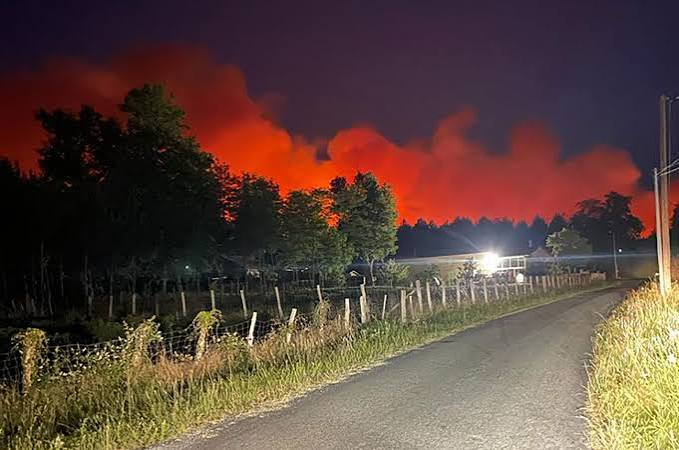
There is much discussion about the smoke damage to the grape harvest this year, with conflicting views in the wine industry and beyond.
Can we really know yet?
When wildfires got close to Bordeaux in July (2026), aside from the concern for the population, there was a huge worry that the region’s vineyards could be in danger and the possibility that smoke could affect the flavour and commercial value of the 2026 vintage, about to be harvested.
An article published by Insurance Business raised the prospect of smoke taint becoming a “slow-burn” insurance claim: damage that might not be apparent when grapes were picked but could emerge during fermentation, ageing or even after bottling. Clearly of great interest to the insurance sector.
It is a legitimate risk to consider. However, given that the harvest has now started (at least 2 weeks early), evidence now available indicates that Bordeaux’s vineyards and 2026 grape harvest have not been materially affected by smoke.
The strongest indication that things seem to be ok, is that the harvest is proceeding. Signs are good.
Vineyards producing Crémant de Bordeaux (one of my favourite sparkling wines) began picking grapes in early August. This was not as a result of the fires; these grapes are always harvested relatively early because sparkling wine production requires acidity and lower sugar levels in the grapes, so they are picked young.
Some Bordeaux Grand Cru estates were expected to begin harvesting from today, 17th August. This is so early compared with normal harvest timetable, usually the first or second week of September.
An early harvest is not unprecedented; in 1893, harvest started on August 15th during another very hot summer. They are not just a thing of the last century. 😁
The heat and prolonged sunshine, rather than the fires, have precipitated this early harvest. Grapes have ripened more quickly, creating a need to pick before sugar levels become excessive and wines risk becoming overly alcoholic or “jammy”. Some of us like “jammy” but only to a point.
The good news is that the Bordeaux wine trade body remains positive about the quality of the wine that will be produced this vintage.
Sara Briot-Lesage of the Conseil Interprofessionnel du Vin de Bordeaux (CIVB) said, in an article published by The Connexion, that the vintage showed “great promise of exceptional quality”.
Although smoke covered much of the Bordeaux wine region for a few days, the areas that were actually burnt were not wine growing areas, but nearer the pine forests on the Atlantic coast.
It is reported that the nearest vineyards were approximately 15 kilometres from the point at which the fire was contained. Phew!
Earlier reports on Euronews concurred with Ms Briot-Lesage’s opinion that Bordeaux’s vineyards had escaped direct fire damage.
So why were many of us (in the wine industry) so convinced that there would be smoke taint?
Smoke taint is a real phenomenon, a genuine concern, but smoke in the atmosphere does not automatically produce tainted grapes or wine apparently.
An unwanted smokey flavour develops when grapes absorb particular volatile phenolic compounds released when nearby vegetation burns. During fermentation, these compounds can produce ashy, medicinal or smoky characteristics.
The CIVB said that research following California’s wildfire experience and the 2022 fires in Bordeaux, have shown that smoke taint usually occurs where fires are within a few hundred metres of vines i.e very, very close. The greatest exposure is normally during the first 24 hours, when smoke from a fire is most intense.
The recent Bordeaux fires did not get that close.
In addition, the grapes were only at the beginning or middle of “véraison”, which is the stage when grapes change colour, swell and soften. Fortunately the grape skin is still tough enough to provide a natural barrier that limits the absorption of smoke compounds. Good that they are thick skinned … at least for now.
As mentioned, Bordeaux faced similar concerns following the major wildfires of 2022 when there was also considerable discussion about the possibility of smoke taint. In the end, reported effects were restricted to isolated parcels in Graves situated immediately beside the fire. Interestingly, for the doomsayers, grapes from those parcels were not used in the final wine blends.
Colin Hay, The Drinks Business’ Bordeaux correspondent, cautioned in a rcent article, against assuming that the presence of smoke means an entire region’s wine has been compromised, reiterating that the proximity, or rather distance, of the grapes to the fire is a key factor.
Bordeaux producer Stéphane Defraine has also offered reassurance. His estate is approximately 60 kilometres from the fires, and he said the distance meant there would be no problem for his wines.
HOWEVER…
The insurance warning I referenced above, identified an issue that needs to be considered carefully. Smoke taint can be difficult to detect before fermentation and may create complications later.
Continued testing and observation during fermentation will go on, which is usual anyway, and it is possible that some smoke related characteristics may emerge later in the winemaking process. Who knows if this will be a bad thing?
Nevertheless, the evidence available today, both factual and anecdotal, shows an optimistic, if conditional, outlook: Bordeaux’s 2026 grape harvest has not been affected by smoke, as far as producers, the regional trade body and current reporting can establish.
The vintage has undoubtedly been affected by heat, drought and extraordinarily early ripening. But it should not be written off because of smoke.